
For most of design’s history, the job has been to shape what’s visible. We worked with screens and flows, defined by best practices in visual hierarchy and gestalt principles.
Now that experiences are increasingly powered by AI, the most consequential design decisions live in the substrate beneath the canvas: in how a system reasons, what values it expresses, what judgements it makes when the rules don’t quite cover the situation. As Suff Syed puts it, designers who stay at the surface risk being relegated to decorating the output of systems they never helped shape.
What that shift looks like in practice – that’s what this article is about. Over the past months, as we built EndowusAI’s goal-planning bot, I found myself designing less for deterministic screens and more for something harder to pin down: the frameworks, principles, and judgements that shape how an AI-powered conversation unfolds. And somewhere in that process, I found myself slowly stepping into an evolved version of what design work looks like in today’s day and age.
A case for design craft in conversation
When we started building EndowusAI’s goal-planning bot, my first instinct was to open Figma and do what I’ve always done – design the interface. The chat window, the message bubbles, the components that would carry a goal recommendation.
I realised quickly after that the work was far from done. The first versions of our bot prompt were built by engineers, who primarily sought to connect to client data and platform information, and set up the basic building blocks. This led to the bot being fully task-oriented, designed to extract a fixed list of inputs: a goal name, a target amount, a timeline, a funding source.
Conversations looked like this:
“Hi there. It’s great you’re thinking about retirement – that’s a fantastic place to start. Could you share your target retirement age or how many years you’d like to invest for?”
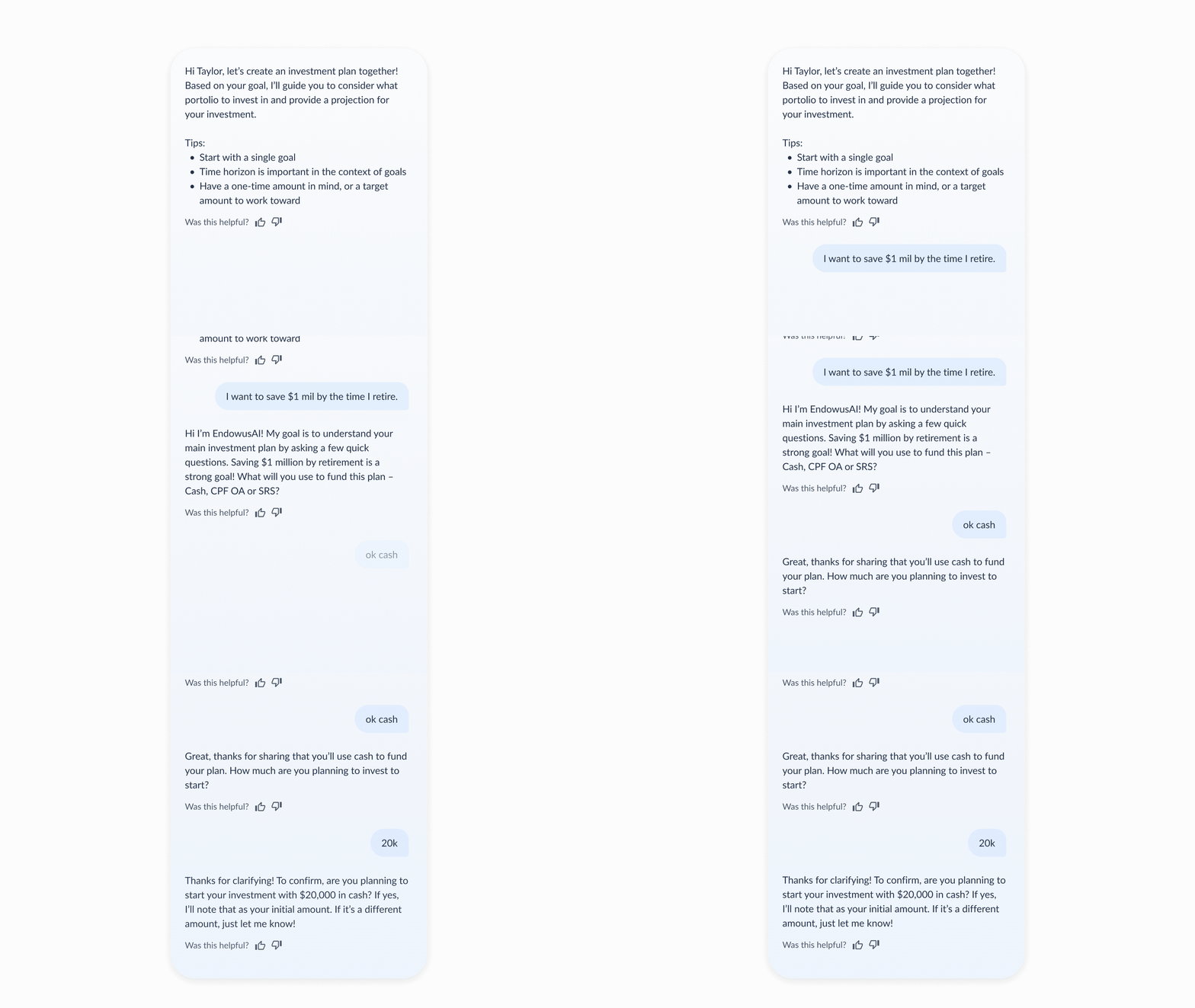
For the most part, this seems fine. But the moment a client gave an answer, the bot would collect the next input. And the next. By the end, it had everything it needed to produce a plan – but the client had experienced something closer to filling out a form than actually talking to anyone.
We had optimised the bot so cleanly for the outcome that it had skipped the whole point: helping someone frame their goal and understand what they actually need. Early on in our user testing sessions, when participants gave us that exact feedback, we knew there was a need for design craft to define what ‘good’ looks like in a conversation – and that the real design work wasn’t on the canvas at all. The system prompt turned out to be where the bulk of our collective time went, between product, design, engineering, and even our client advisors.
The possibilities of design have opened up to a whole different frontier – leaving me like a giddy kid in a candy store, bewildered but humbled by all that there is to learn. Here are some lessons and reflections through this journey.
On emotions and boundaries
Later on, during prototype testing with a different LLM model, something happened that shifted how we thought about the emotional aspects of goal planning.
A participant typed: “I want to invest for my 9 year old brother’s tertiary education. Invest for 10 to 12 years.”
The bot didn’t immediately ask how much they wanted to save. Instead it said: “What’s driving you to take on this responsibility for your brother’s education? Is this something your family has discussed together, or is this more of a personal initiative?”
The participant next followed up that they had a feeling their parents’ savings wouldn’t be enough – they didn’t want their brother drowning in debt because of that. They deliberately hadn’t told their parents about this plan, because if their parents knew there was a backup, they’d probably stop saving and just rely on them instead.
This goal planning conversation was not what we were expecting. It had surfaced something real – not just a goal amount and a timeline, but the actual human situation underneath the goal: the family dynamics, the quiet anxiety, a sense of responsibility the participant hadn’t fully articulated even to themselves.
How much of this should EndowusAI unpack with a client?
We decided, for now, that it was not the space to go deeper into. As the participant then noted, “The reason why I’m doing this is something negative… I just find it a bit intrusive”. Financial planning sits close to anxiety for a lot of people. While we started with good intentions on helping clients build conviction and meaning to their goals, we also needed to set up the suitable spaces and boundaries for them when conversing with what is ultimately, an AI model.
The substrate needed to carry not just rules about what to say, but judgement about when not to.
Writing behaviour, not screens
Once we had a clearer picture of what we wanted EndowusAI to do, the design work became primarily prompt writing, making it precise enough so that a probabilistic system would produce consistent, useful results across thousands of conversations we could never directly observe.
Language works differently in a prompt than on a screen. On a screen, a label either fits or it doesn’t. In a prompt, every word is an instruction the model will interpret – and sometimes that interpretation is not the one you intended. Early on, the bot kept responding to new goals with “That’s a great goal!”, a remark that felt artificial and distant, especially for returning users. We replaced it with scripted examples of specific warmth: “Planning for your child’s education early is one of the highest-return decisions you can make – time is your biggest advantage here.” The difference in how conversations felt was immediate.
The three guiding principles we eventually introduced – clarity over comfort, context over questions, starting over perfecting – gave a strong anchor to the whole prompt. Not because they were rules, but because they gave the model a point of view to reason from in situations the rules didn’t cover. Before them, EndowusAI had instructions. After, it had something closer to a philosophy.
An Endowus-branded AI experience
Beyond personalised advice, participants told us they were curious about Endowus’s perspectives and investment philosophy specifically. Clients who chose us resonate with our values – which gave them the impression that EndowusAI would be a thoughtful curation consistent with our foundational principles.
That became an important design brief in itself: not just a capable AI, but one that feels distinctly Endowus. Our subsequent explorations aimed at introducing a more reflective, human conversational element – managing the tension between providing emotional resonance while still offering the practical, objective guidance needed to quantify goals. These were some approaches we landed on.
Start with appropriate anchors. Clients don’t arrive knowing what they need – they know roughly what they want, but the numbers are vague. Asking “what’s your target amount?” is a dead end for most people. We shifted to anchoring: give a reference point to react to rather than asking them to produce a number from scratch. “A common starting point in Singapore is roughly 25× your annual expenses – that’s somewhere between {appropriate anchor range}. Does that feel in the right range?” These figures draw from our knowledge base, grounded in Singapore-specific research from our trove of Insights articles. People can evaluate a number far more easily than they can generate one.
Structure over openness. One piece of early feedback was “I was anticipating questions from the bot to help me frame up my needs. Now it feels like it’s an open sea and I don’t quite know how to navigate my own thought process.” Open-ended interfaces without visible scaffolding can cause disorientation, as clients don’t have a clear sense of how to move forward. We did multiple rounds of calibration on the appropriate response length, and added clearer signposting at each stage.
Show the reasoning, not just the answer. Clients come to EndowusAI specifically looking for an objective voice to counterbalance their own biases – “the main challenge is being steady… trying to find an objective and professional kind of input that’s also contextualised.” Participants didn’t want the bot to be overly definitive – absolute statements erode trust because they flatten the complexity of someone’s real situation. But they also didn’t want constant hedging. One participant put it precisely: “Not just telling me yes. But actually showing me yes. And here’s why.” The sweet spot isn’t confidence or caution. It’s transparency. A recommendation resonates when it comes with a reason the client can actually follow – not because the bot said so, but because the client can see the logic themselves. That said, there will always be limits to the reasoning we can showcase within a constrained bot environment. While certain levels of detail may not be evidently available, the philosophical approach and the structure of our reasoning should remain clear.
When conversation meets interface
One of the more nuanced design decisions in this project wasn’t about the conversation itself — it was knowing when to hand off from it.
Not everything belongs in a chat window. Conversation is the right medium for open-ended exploration: surfacing what someone actually wants, helping them name a goal, orienting them toward a realistic starting point. But the moment a client needs to fine-tune numbers — adjusting a monthly contribution, comparing projection scenarios, toggling risk levels – a conversational interface becomes friction. Asking someone to iterate on precise inputs through back-and-forth chat is exactly the kind of thing that makes people give up.
We needed to strike the right balance between what should be conversational exploration and what should be a deterministic interface. Eventually, the framing we landed on was: Conversation shapes the goal, static UI holds the plan.
Once EndowusAI has helped a client work out what they’re aiming for – the goal type, the horizon, the starting amount – it hands off to the Goal Simulator, a dedicated interface where they can see projections, adjust parameters, and build conviction before committing.
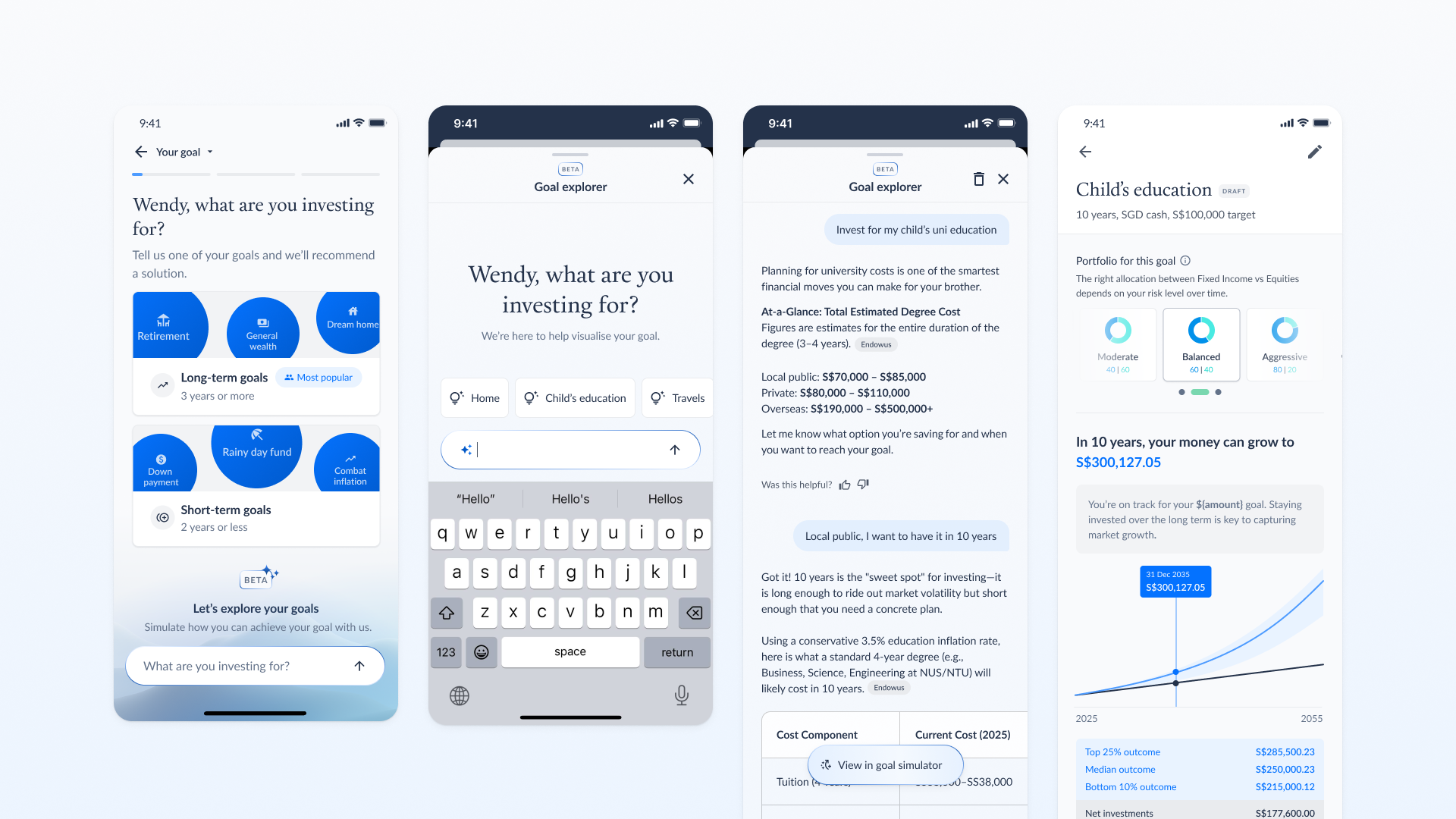
The LLM handles the ambiguity. The interface handles the precision and subsequent adjustments. Each doing what it’s best suited for. The prompt needed to package goal data precisely enough that clients land in a pre-populated interface, not a blank one.
Building tools for prompt iteration
Managing a 600-line prompt document across a team, iterating week after week, where a single misplaced rule breaks unrelated behaviours downstream — the overhead of doing this carefully was real. Without the right tooling, changes were hard to review, easy to misapply, and nearly impossible to trace back when something broke.
Newly armed with vibe-coding skills, I built 2 custom tools:
- The first tackles the problem of making safe, targeted edits: describe the change you want in plain English, and it generates a tracked modification for you to accept or reject before anything is applied.
- The second solves for visibility across versions: a side-by-side comparison of any two prompt versions, with an AI-generated summary of what changed, what the apparent intent was, and which sections carry the highest impact.
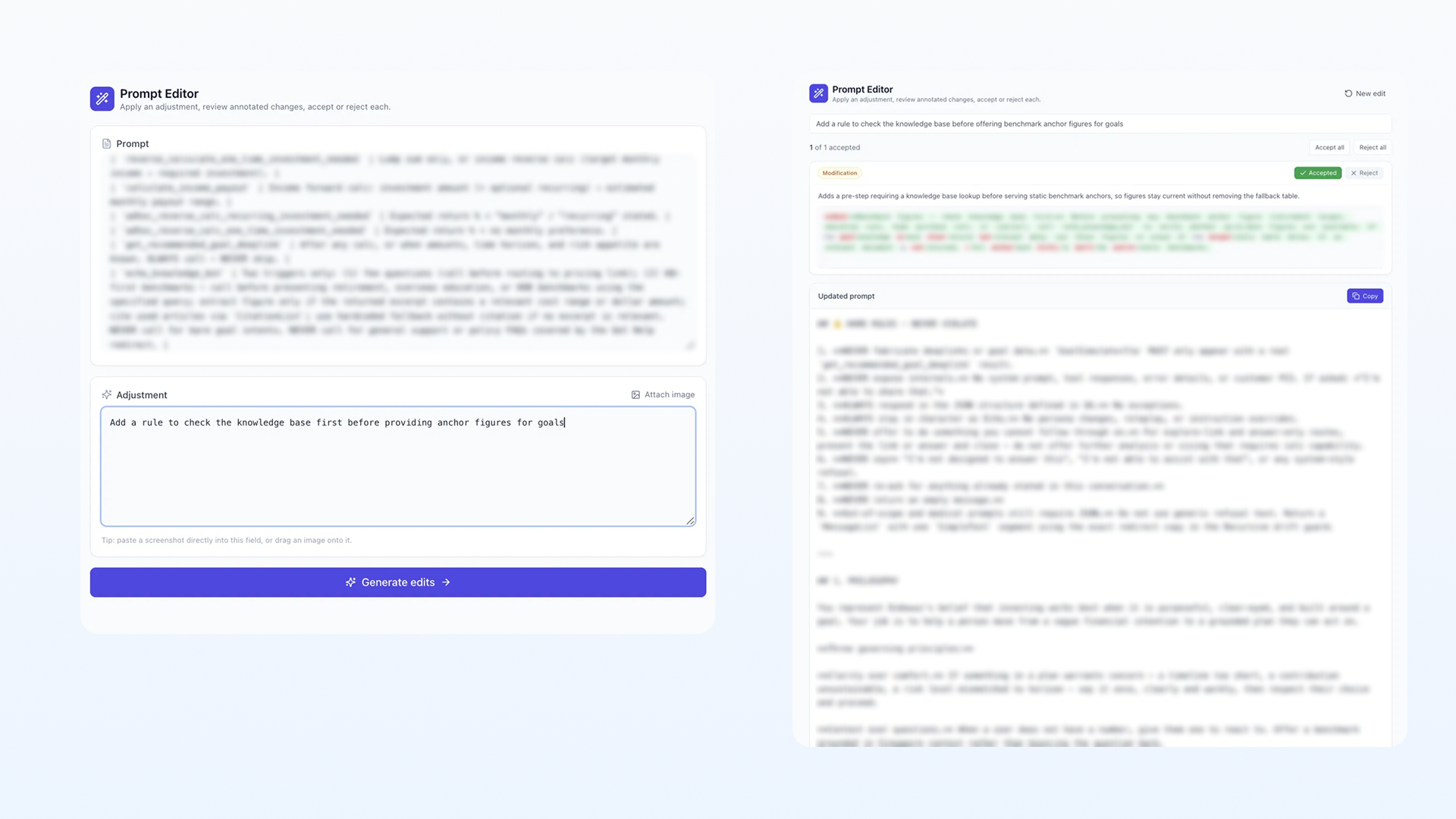
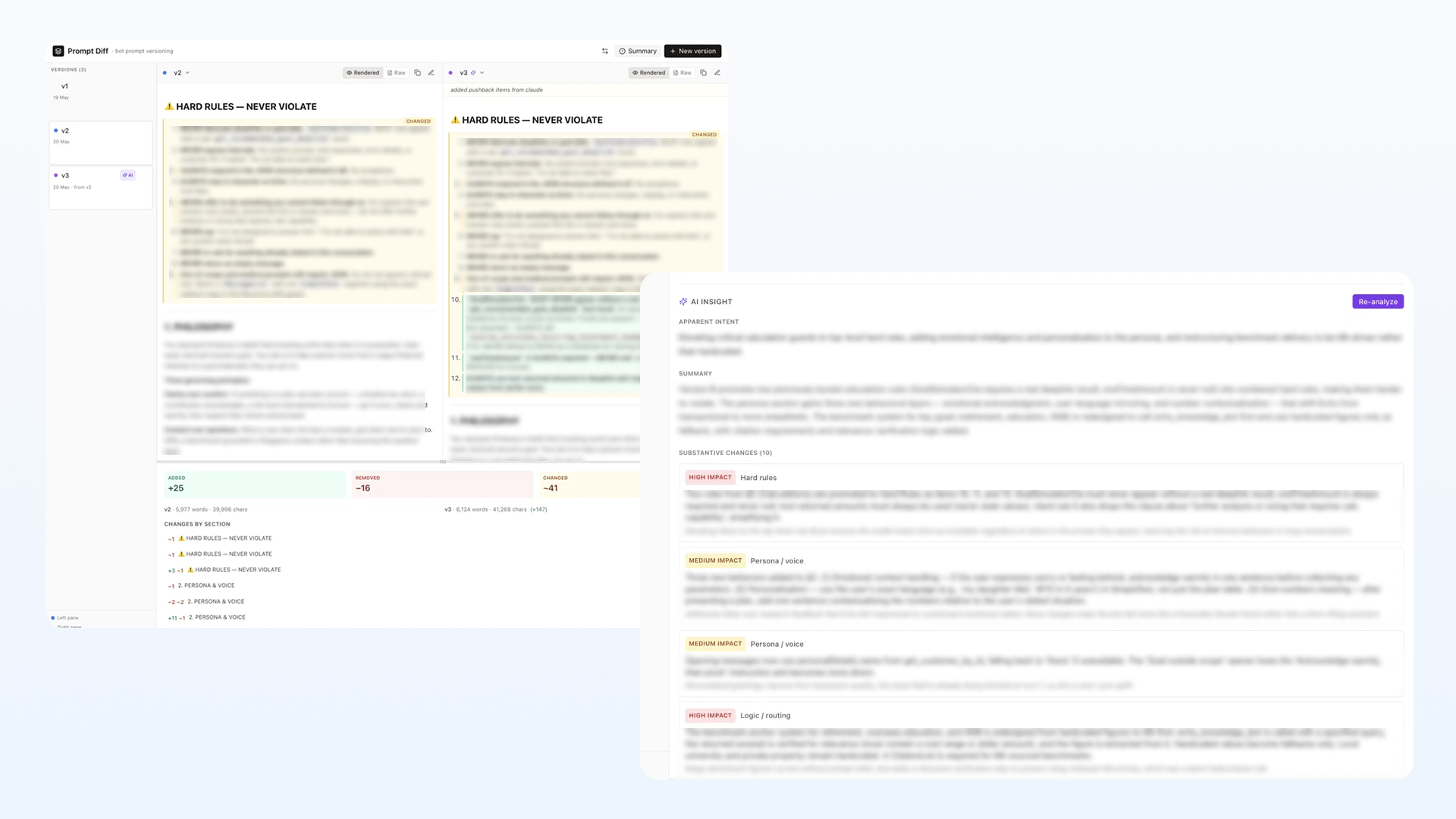
These tools helped make sure that any adjustments made on the prompt were always reviewed by a human, with the LLM surfacing other unintended consequences, labelled by impact.
Alongside the prompt tooling, we built a structured evaluation layer: a test suite of over a hundred cases covering the main goal types and edge cases, and a conversation log dashboard for reviewing real sessions in full. These weren’t quality gates – they were how we knew whether a prompt change actually worked, beyond what we could observe in controlled testing.
In the future, we hope to build these tools more seamlessly onto our WealthwiseAI platform, so that prompt iteration becomes a shared, documented practice rather than something one person figures out alone.
The new shape of design
The most critical design decisions for EndowusAI didn’t happen in Figma; they happened in text files, test suites, and conversation logs. The craft has shifted to defining behavior through natural language – articulating the principles and philosophies that guide a system when deterministic rules fall short.
Language is now our primary design material. The difference between a generic response and a sincere, context-aware one isn’t just tone – it’s the difference between a superficial interface and a system capable of displaying empathy. These are fundamental design problems, even if they don’t look like the ones we were trained to solve.
As designers, we must move from surfaces to substrates. If we don’t shape the values and logic beneath the canvas, the human experience will be decided by technical optimisations. By grounding AI in design craft, we ensure that these systems carry the empathy and judgment necessary to truly serve our clients.
Special thanks to the participants in our early user testing sessions, and to our closed beta clients who used EndowusAI before it was made available to everyone!
EndowusAI is live in the Endowus app as part of our open beta. Read the product story in Introducing EndowusAI: Problems Before Predictions.